What did this report study?
The subject of this explainer is not a survey or a measurement report but a prediction in a press release that Gartner issued from Stamford, Connecticut, on February 19, 2024. It was written with tech marketers in mind and released ahead of the Gartner Tech Growth & Innovation Conference in March that year.
- Type: Prediction, not a measurement
- Published: Press release of February 19, 2024
- Spokesperson: Alan Antin, Vice President Analyst at Gartner
- Underlying report: “Predicts 2024: How GenAI Will Reshape Tech Marketing”, available to Gartner clients only
- Not disclosed: The baseline, the definition of “search engine volume”, the method and the regions covered
Source: Gartner press release (February 19, 2024)
What are the key figures?
| Item | Figure | Condition and base |
|---|---|---|
| Drop in traditional search engine volume by 2026 | 25% | Gartner prediction (published February 2024). Baseline, definition and region not given in the release |
The 25% is the only search volume prediction figure in the release. Gartner explains that traditional search engine volume will fall as search marketing loses market share to AI chatbots and other virtual agents.
Antin noted that organic and paid search are vital channels for tech marketers seeking to reach awareness and demand generation goals. He then said that generative AI solutions are becoming substitute answer engines, replacing queries that previously may have been run in traditional search engines, and that this will force companies to rethink their marketing channel strategy as generative AI becomes more embedded across the enterprise.
Source: Gartner press release (February 19, 2024)
What does it mean?
Alongside the volume prediction, the release adds an outlook on content.
- Quality will matter more. As generative AI drives down the cost of producing content, activities such as keyword strategy and website domain authority scoring are affected, and search algorithms will value content quality more to offset the sheer amount of AI-generated content.
- Authentication will get more emphasis. Watermarking and other ways to authenticate high-value content will matter more. Gartner said governments were already beginning to require the identification of AI-created marketing content, and that this will likely play a role in how search engines display it.
- Produce useful, unique content. Antin said companies need to focus on unique content that is useful to customers and prospective customers, and that content should keep demonstrating search quality-rater elements such as expertise, experience, authoritativeness and trustworthiness.
This advice can be read as saying that useful, well-sourced content is the baseline, whether for search engines or AI answers. Organizing information so that AI can read and cite it accurately is covered in How Do AEO and GEO Differ?.
Public counterpoints and other accounts
- An industry outlet stressed that it is a prediction: On the day of the announcement, the search industry outlet Search Engine Land noted that the prediction was shared in a press release based on research that requires a subscription, and that predictions, however informed, are best guesses.
- Google’s official account: In a statement of May 7, 2025 on press reports about Search traffic, Google said it continues to see overall query growth in Search. The statement gives no figures and describes queries on Google alone.
Neither source rules on whether Gartner’s prediction was right. This explainer does not draw a conclusion on whether volume actually fell 25% by 2026 either.
Source: Search Engine Land, Will traffic from search engines fall 25% by 2026? · Google, statement on May 7 press reports about Search traffic
What does it mean for companies in Korea?
Gartner’s prediction does not name the regions it covers and gives no figures for the Korean search market. The 25% cannot be carried over as a change in Korean search volume.
Still, its premise that some questions are moving from search engines to AI answers is worth checking in Korea. As checked by AIO2O on September 29, 2026, the robots.txt files of Naver Blog (blog.naver.com) and Naver Map (map.naver.com) have rules that block major AI crawlers such as GPTBot, ClaudeBot and PerplexityBot. The check is documented in How Do AEO and GEO Differ?. For a company that keeps its information mainly on Naver Blog or Naver Map, that information may be hard for those AIs to collect directly when customers put the same questions to AI chatbots.
For such a company, a practical response is to keep Naver channels running while also keeping an official page that AI crawlers can read, with company information and answers to common questions backed by sources.
What should you check now?
- Check that your official website’s robots.txt does not block AI crawlers such as GPTBot, OAI-SearchBot, ClaudeBot and PerplexityBot.
- Use the questions customers actually ask as headings, and give the answer first in the opening paragraph.
- Check whether the expertise, experience, authoritativeness and trustworthiness Gartner highlights can be seen on the page. State who wrote it, the sources and the last-updated date, and keep company information consistent.
- Look at your own data rather than outside forecasts. Track search traffic over time, and record whether your brand is mentioned when you put the same customer questions to several AIs in the same wording.
What to keep in mind when reading this report
- It is a prediction. The 25% is a prediction made in February 2024, not a measurement. Do not restate it as “search volume fell 25%”.
- The basis is not public. The baseline, the definition of search volume (number of searches or site visits, for example), the method and the regions are not in the public press release. The underlying report is for Gartner clients only.
- Do not assume the outcome. We did not find an official source that checks the prediction against actual results. Google’s “query growth” statement is one company’s account without figures, so it alone does not show the prediction was wrong.
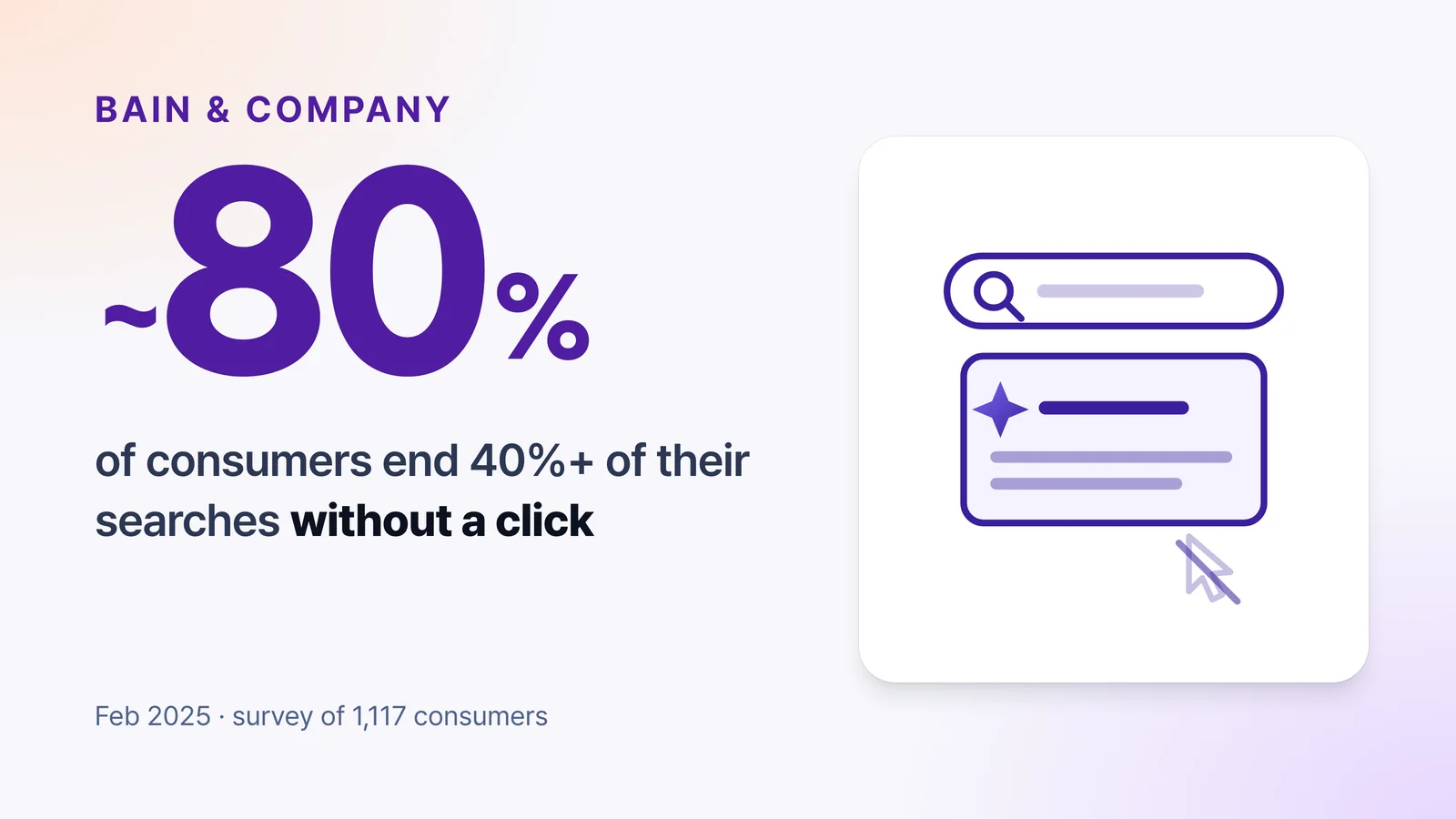
- The reports discuss different metrics. Gartner covers traditional search engine volume, Bain covers zero-click searches and organic web traffic, and McKinsey covers traffic from traditional search. Check what was counted before putting the figures side by side.
- It was written for tech marketers. The release has tech marketers in mind, and the underlying report covers tech marketing. Whether it applies equally to other industries cannot be told from the release alone.
Two reports that use different metrics are explained in the McKinsey report explainer and the Bain report explainer. The full list is in the global reports hub.