What did this report study?
“New front door to the internet: Winning in the age of AI search” is an article from McKinsey & Company’s Growth, Marketing & Sales Practice, published on October 16, 2025. It looks at what it means for brands that consumers now use AI apps such as ChatGPT, Gemini, Copilot, Perplexity and Claude, as well as Google’s AI Overview, to research options and choose brands.
- Type: An analysis article combining a consumer survey, an executive survey, McKinsey’s own analysis and projections
- Consumer survey: McKinsey AI Discovery Survey, a representative US consumer panel, n = 1,927, August 2025
- Brand survey: About 30 CMOs of Fortune 500 consumer brands, September 2025
- Source analysis: McKinsey’s analysis of the sources behind Google AI Overview answers
- Projections: The revenue figure and the traffic decline range are McKinsey projections and analysis
Source: McKinsey, New front door to the internet
What are the key figures?
| Item | Figure | Condition and base |
|---|---|---|
| Consumers who intentionally seek out AI-powered search engines | Half (50%) | 1,927 US consumers, survey of August 2025 |
| Call AI-powered search their primary and preferred source of insight | 44% | AI-powered search users in the same survey. Traditional search 31%, retailer or brand websites 9%, review sites 6% |
| US revenue that will funnel through AI-powered search by 2028 | $750 billion | McKinsey projection |
| Possible decline in traffic from traditional search for unprepared brands | 20 to 50% | McKinsey analysis and projection |
| Share of AI search sources that are a brand’s own sites | 5 to 10% | In many cases. McKinsey analysis of Google AI Overview |
| Brands that systematically track AI search performance | 16% | About 30 Fortune 500 consumer brand CMOs, survey of September 2025 |
McKinsey sees the use of AI-powered search for buying decisions as already widespread. In its survey, a majority of users said it is the top digital source they use to make buying decisions, and McKinsey notes that a majority of older generations, such as baby boomers, are already adopting it.
The article also looks at where answers come from. Based on its analysis of Google AI Overview, McKinsey says that in industries such as consumer packaged goods and financial services, more than 65 percent of sources across AI-powered searches are publishers (magazines and microsites), user-generated content and affiliate sites. Drawing on the same Google AI Overview analysis and its experience, it adds that even industry leaders’ GEO performance may lag their SEO performance by 20 to 50 percent. This figure is separate from the projected decline in traditional search traffic in the table above.
Source: McKinsey, New front door to the internet
What does it mean?
McKinsey’s argument is that the moment of decision is moving inside AI answers. The clicks that remain on traditional search are more likely to come from informed consumers further along the purchase funnel. So SEO alone no longer covers the touchpoints where consumers decide, and gen AI engine optimization (GEO) needs to become a key part of marketing and digital strategy.
It explains brand absence through the spread of sources. SEO focuses on a brand’s own site, but AI-powered search builds answers from a broad range of sources, including affiliates and user-generated content. Those sources vary by model, location, category and question type, and McKinsey expects them to most likely evolve as LLMs evolve. McKinsey says that in major categories such as credit cards, hotels, electronics and apparel, top brands can be absent from some answers, and concludes that traditional brand strength does not guarantee visibility in AI search.
McKinsey recommends four moves.
- Run a diagnostic. Assess visibility and sentiment across AI search platforms, find the sources that drive results, and estimate the value at risk.
- Adjust content investment. Cover the full range of content that AI answers are built on: owned content, third-party content and communities.
- Optimize content. Strengthen credibility and relevance with new, unique information, and improve structure with clear headings and precise language.
- Build GEO as a core capability. Set up a cross-functional team spanning marketing, SEO and customer experience, and track progress with GEO-specific KPIs.
These recommendations can be read as organizing both owned and external information so that AI can read and cite it accurately. For how AEO and GEO differ, see How Do AEO and GEO Differ? and the glossary.
What does it mean for companies in Korea?
The consumer sample is US consumers, and the source analysis covers Google AI Overview. These figures cannot be carried over as figures for Korean consumers or the Korean search environment.
Still, the point that a brand’s own site is only one part of what AI answers draw on is worth checking in Korea. As checked by AIO2O on September 29, 2026, the robots.txt files of Naver Blog (blog.naver.com) and Naver Map (map.naver.com) have rules that block major AI crawlers such as GPTBot, ClaudeBot and PerplexityBot. The check is documented in How Do AEO and GEO Differ?. For a company that keeps its information mainly on Naver Blog or Naver Map, that information may be hard for those AIs to collect directly.
For such a company, McKinsey’s advice can be read as keeping Naver channels running while also keeping an official page that AI crawlers can read, with company information and answers to common questions backed by sources.
What should you check now?
- Check that your official website’s robots.txt does not block AI crawlers such as GPTBot, OAI-SearchBot, ClaudeBot and PerplexityBot.
- Use the questions customers actually ask as headings, and give the answer first in the opening paragraph.
- Make sure the company name, address, contact details and product names are written the same way on your site and on external channels.
- Pick a few questions customers ask, put them to several AIs in the same wording repeatedly, and record whether your brand is mentioned and which sources are cited.
- If the cited sources include media, reviews or community posts you do not own, check that what they say matches your official information.
What to keep in mind when reading this report
- It is a US consumer survey. The consumer figures are responses from a representative US consumer panel of 1,927 people in August 2025. Do not carry them over to other countries.
- The 16% comes from a small sample. The 16% of brands that systematically track AI search performance is based on about 30 Fortune 500 consumer brand CMOs. The sample is too small to read as a rate for companies in general.
- Separate projections from measurements. The $750 billion and the 20 to 50 percent decline in traditional search traffic are McKinsey projections and analysis, and the article does not disclose how they were calculated.
- The source share comes from Google AI Overview analysis. The 5 to 10 percent for brand sites describes “many cases”, and McKinsey itself says sources vary by model, location, category and question type.
- Check the definition of GEO. McKinsey uses GEO for gen AI engine optimization. It points in the same direction as generative engine optimization in other sources, but check each source’s definition before comparing.
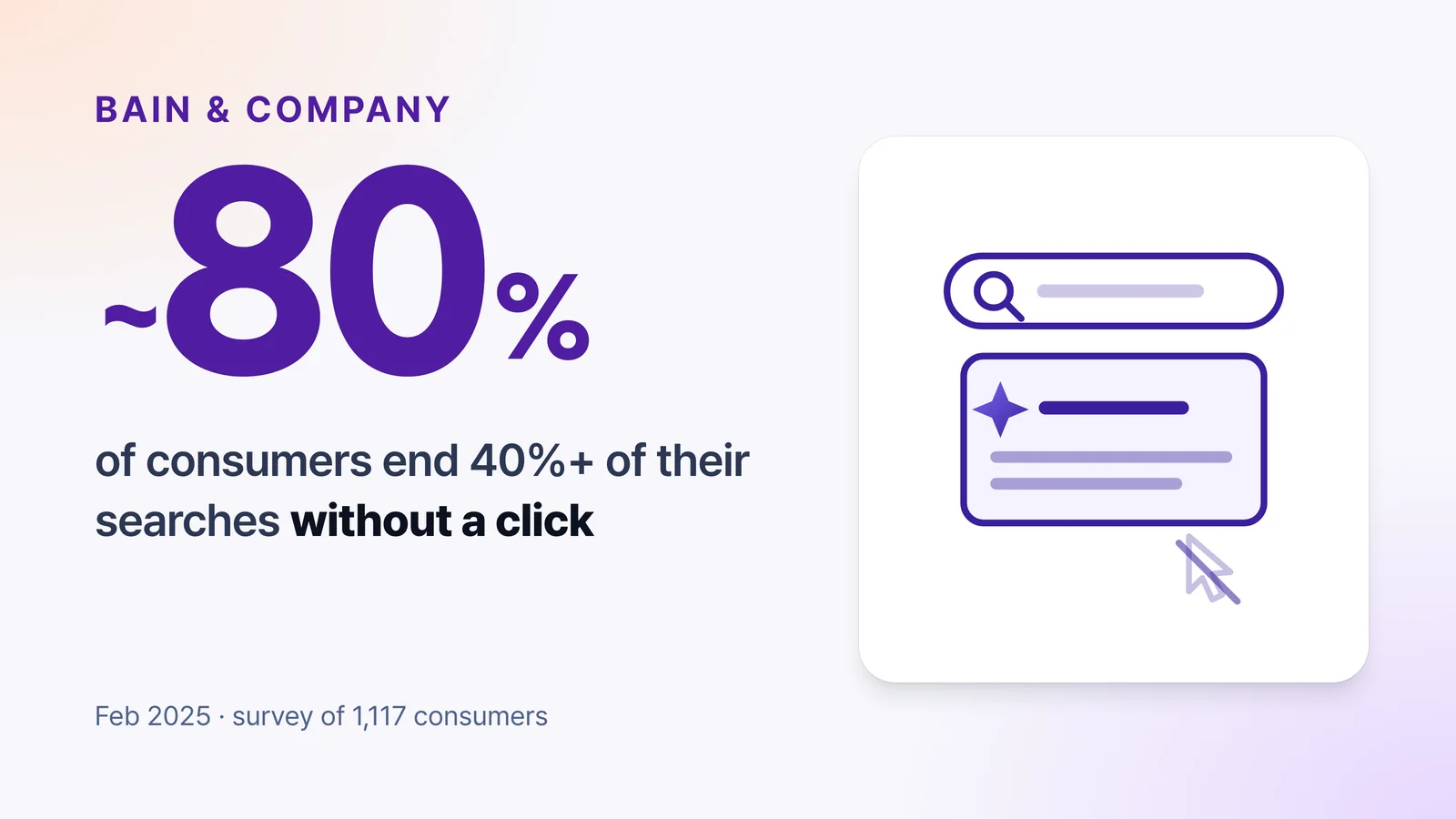
See also the Bain report explainer on zero-click search, the Gartner forecast explainer on search volume, and the global reports hub.